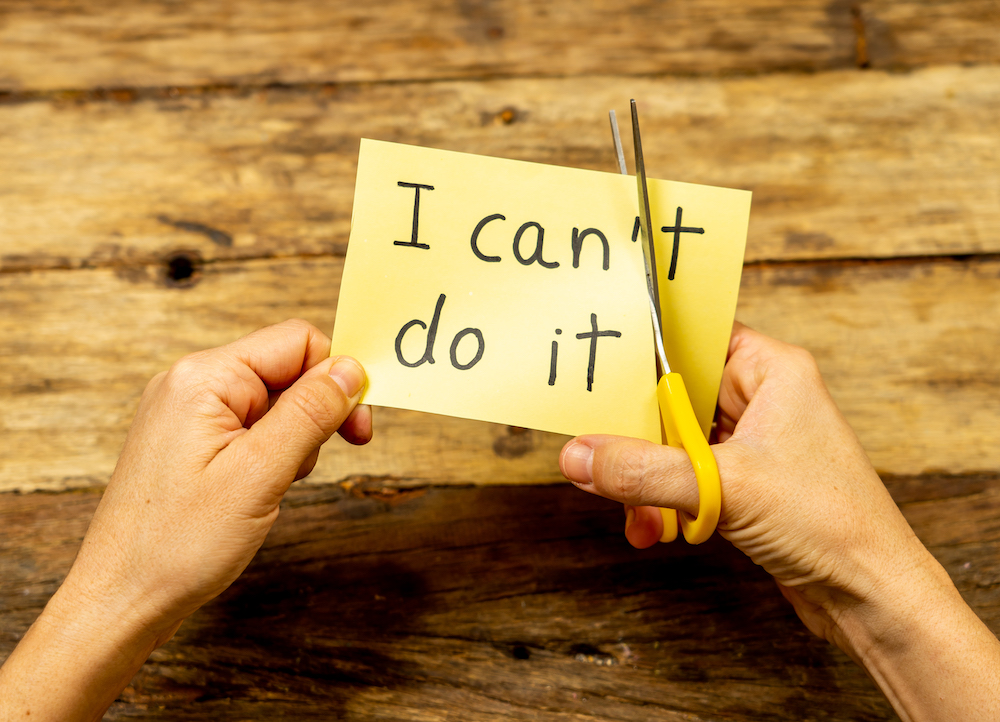
Building on last week’s language hack (avoid using “try” in your daily communication with yourself and others), today, let’s talk about the use of can’t and should 🙂
These pesky little words can be so incredibly disempowering.
Want to feel like a victim of circumstances and stay completely out of touch with your own power? Then sprinkle words like “can’t” and “should” and “have to” into all your sentences.
Humans have a tendency to shut down when we are being told what to do. We get all tied up between rebelling against demands or submitting resentfully to them.
Whether I am “should-ing” on myself or on others, the word “should” constricts and contracts my whole body ever so slightly.
Try it for yourself and see.
I brace myself against whatever I am about to hear – however well-intentioned the speaker may be.
“Should” carries layers of judgment, moralism and control, and often feelings of shame are quick to follow. No matter how brilliant the advice to ourselves or others might be, delivering wisdom in a “should” package taints it by adding a bossy quality, a one-up quality, a condescending quality.
When we have some brilliant advice to share (with ourselves or others), here are some new phrases to gift wrap it in:
I /you could …
I would like to …
One option I have it to …
One possibility would be to …
Are you open to considering …
Another option might be to …
A wiser choice might be …
Would it be wise to consider …
And what about “can’t”?
OK, so there are some times where it would be entirely appropriate to use, for example, “I can’t lift my car out of the snow bank” or “I can’t meet you for croissants in Paris tomorrow since I am basking on a beach in Bali,” but when we overuse this word in most other situations we contribute to our own disempowerment.
Saying “I can’t” is a subtle way of giving my power away to something outside of myself: another human, a system, a belief set, a prediction, a weird relationship dynamic, my unconscious drivers.
For example, when I catch ourselves saying something like, “I can’t play with you today because I have to go to work,” I’m conveying to myself and others a sense of powerlessness that keeps me enslaved to expectations outside of myself. We can fool ourselves and others into believing we have no choice in the matter – when we actually do.
We can live as sovereign, empowered beings. (Although many of us don’t default to this – yet.)
We can absolutely choose to play first and work second, even though so few of us give ourselves permission to do so.
Claiming that we “can’t” do something simply affirms the part of ourselves operating from a victim mentality and denies our power to choose what we want in our lives.
Let’s instead inhabit a co-creative and empowered internal space.
For example, we could say something like, “I’m working today, but I would love to play with you all day on Thursday – are you free?”
This approach both honors our free will and also takes responsibility for the choices we make in our lives. And, we can show up more empowered, with self-responsibility, good-will and gratitude.
Isn’t that much more fun than defeated, worn down and victimized by all the things you should do and can’t do?
Instead of using “can’t”, you may want to try these phrases:
I am not available for …
I am not going to …
I am choosing to/not to …
I am committed to …
I get to …
Let’s stop giving away power to imaginary others: the systems, the imagined judgments others might have, the internalized beliefs that no longer serve us.
Instead, let’s stand firmly in claiming full responsibility for the choices we are making each day, while not blaming external circumstances by couching our “no’s” to other people in “can’t” language. Simply changing shoulds to coulds, and using more choice-focused words are two small language hacks that can support you in cultivating more integrity, empowerment and freedom in your daily life.





One Response
Thank you for this. Many people will try to substitute “I ‘get’ to” when they used to say “I ‘have’ to.” While i UNDERSTAND that the shift is one from victimhood to gratiTude, i felt a little gaslighty to me. I found my agency again when i reframed my “have tos” to “i choose to.” it fit me so much better to say “I choose to pay my bills,” instead if “i get to pay my bills.” This simple shift reminded me that, yeah, i could choose to not to engage in these adult activities, but do i really “choose” those outcomes too? No, i like electricity and food, so back to work i go.